Russia - Series: Russian Ballet
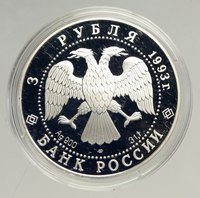
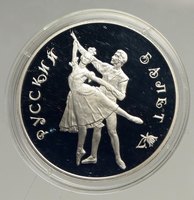
1993 Proof Silver 3 Roubles 39mm (34.62 grams) 0.900 Silver (1.0000 oz. ASW)
Reference: Y# 323
3 РУБЛЯ 1993г. Ag 900 ЛМД 31,1 БАНК РОССИИ, The Emblem of the Bank of Russia
РУССКИЙ БАЛЕТ, In the center, a dancing ballet duet. You are bidding on the exact item pictured, provided with a Certificate of Authenticity and Lifetime Guarantee of Authenticity.
 Russian ballet, a national school of dance with traditions based on Russian folk dances and the achievements of different ballet schools of the world. Russian ballet dancers, choreographers and instructors made a great contribution to the establishment of the well-known ballet schools. The ballet theatre has been existing in Russia since the middle of the XVIIIth century. The Russian school of ballet has received international recognition. Russian ballet, a national school of dance with traditions based on Russian folk dances and the achievements of different ballet schools of the world. Russian ballet dancers, choreographers and instructors made a great contribution to the establishment of the well-known ballet schools. The ballet theatre has been existing in Russia since the middle of the XVIIIth century. The Russian school of ballet has received international recognition.Imperial Russian Ballet Until 1689, ballet in Russia was nonexistent. The Tsarist control and isolationism in Russia allowed for little influence from the West. It wasn't until the rise of Peter the Great that Russian society opened up to the West. St. Petersburg was erected to embrace the West and compete against Moscow's isolationism. Peter the Great created a new Russia which rivaled the society of the West with magnificent courts and palaces. His vision was to challenge the west. Classical ballet entered the realm of Russia not as entertainment, but as a "standard of physical comportment to be emulated and internalized-an idealized way of behaving."[1] The aim was not to entertain the masses of Russians, but to cultivate a new Russian people. Empress Anna, (1730 - 1740) was devoted to ostentatious amusements (balls, fireworks, tableaux), and in the summer of 1734 ordered the appointment of Jean-Baptiste Landé as dancing-master in the military academy she had founded in 1731 for sons of the nobility. In 1738, he became ballet master and head of the new ballet school, launching the advanced study of ballet in Russia, and winning the patronage of elite families. France provided many leaders such as Charles Didelot in St Petersburg (1801-1831), Jules Perrot (1848-1859) and Arthur Saint-Léon (1859-69). In the early 19th century, the theaters were opened up to anyone who could afford a ticket. A seating section called a rayok, or 'paradise gallery', consisted of simple wooden benches. This allowed non-wealthy people access to the ballet, because tickets in this section were inexpensive. One author describes the Imperial ballet as "unlike that of any other country in the world...the most prestigious of the ballet troupes were those attached to the state-supported theatres. The directors of these companies were personally appointed by the tsar, and all the dancers were, in a sense, Imperial servants. In the theatre, the men in the audience always remained standing until the tsar entered his box and, out of respect, after the performance they remained in their places until he had departed. Curtain calls were arranged according to a strict pattern: first, the ballerina bowed to the tsar's box, then to that of the theater director, and finally to the general public. Ballets Russes By the early 1900s the Russian ballet went beyond its borders and infiltrated Paris. It had become its own force and was distinctly Russian, while still being embraced by the Parisian society. In 1903 Ivan Clustine, a Russian dancer and choreographer who had started his career at the Bolshoi Theatre, was appointed Maître de ballet at the Paris Opera. Clustine's hiring promoted a frenzy of questions about his nationality and choreographic agenda: "His hiring was thought a direct attempt by the Opera to imitate the Russian company; even he thought as much, maintaining, not without despondency, that inspiration too often came from the north: 'A revolution! A method that people often apply in the country of the tsars.' Clustine, although acknowledging his nationality with pride, harbored none of the revolutionary intentions that some thought an inevitable consequence of being Russian." The Parisians, while denying adoption of the backwards Russian troupe, had distinct Russian influence in their theater. "Despite Clustine's protestations, several features of the Opera's post-1909 ballets, along with its institutional conventions and balletic policy, appeared to betray a Russian influence." The stigma of Russian brutality and force was applied even in Paris. While their style was not only being accepted in Paris, but implemented in Paris theaters, the Ballets Russes were still considered dangerous, even in the theatre of performing art. "The Ballets Russes, at base, became a metaphor for invasion, an eternal force that could engulf and control, could penetrate the membrane of French society, culture and even art itself." The embracing of Russian ballet in the Paris society became a point of contention and French nationalism collided with Russian determination. Questions arose about the Russian intention in the Paris theaters under the title "cultural politics" including "the delimitation of boundaries, the preservation of identity and the nature of relational engagements." Russia was incapable of simply bringing Russian culture to the West, but created a paranoia of intentions wherever they went. In the beginning, the relationship between Russia and France through the arts was a testimony to their political allegiances. "French critics acknowledged a shared choreographic heritage: French ballet had migrated to Russia in the nineteenth century, only to return, decades later, under the guise of the Ballets Russes. The company, then, moored in a history that intertwined both nations, not only contributed to a cultural programme of exchange. The Ballets Russes were a testament to Franco-Russian cooperation, goodwill and support; they represented 'un nouveau resserrement de l'alliance' (a further strengthening of the alliance)." However, the relationship made a negative turn when duplicity amongst the alliance arose. While Russia continued to borrow money from the French banks, "the Russians no longer interested in supporting French culture and colonial politics." This duplicity gave fuel for the paranoia and lack of trust we see in the relationship concerning the arts. The Parisian press spoke of the Ballets Russes in terms of both "enchantement', 'bouleversement' and 'fantaisie'. Yet they also invoked metaphors of invasion, describing the company's Parisian presence in terms of 'assaut' (onslaught) and 'conquete' (conquest)." The dual-faceted relationship can be seen in this expression of both enrapture and contention. One French journalist, Maurice Lefevre, called on his fellow Parisians to see the reality of the Russian invasion as though it was an infestation, "We need to do some soul-searching and ask whether our guests are not about to become our masters." To imply that Russia was about to take over France through performing arts seems to be irrational, but evidence would suggest the fears were real among those in Paris. Ballet companies The first ballet company was the Imperial School of Ballet in St. Petersburg in the 1740s. Sergey Diaghilev, (1872-1929), an enormously important figure in the Russian ballet scene, founded the ballet company Ballets Russes in the 1909. Diaghilev intervened in every aspect of ballet - direction, production, lighting, scenery, and performance. He headquartered his ballet company in Paris. A protégé of Diaghilev, George Balanchine, founded the New York City Ballet in 1948. Today, the Kirov Ballet company (now known as the Mariinsky Ballet) and the Bolshoi company are two world-renowned Russian ballet companies that tour the world. - Mariinsky Ballet (formerly Kirov ballet)
- Bolshoi Ballet
Other Russian ballet companies include: - Ballets Russes, founded in 1909
- Moscow State Academy of Choreography, commonly known as The Bolshoi Ballet Academy, founded in 1773
- Vaganova Academy of Russian Ballet, founded in 1738 as the Imperial Ballet School
- Saint Petersburg Eifman Ballet, founded in 1977
- Mikhailovsky Theatre Ballet, founded in the 1930s
- Perm Theatre Ballet, founded in 1896
- Novosibirsk Theatre Ballet, founded in 1945
- Russian State Ballet of Siberia, founded in 1978
A number of companies have been called, or included in their name, Moscow Ballet.
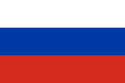 Russia (Russian: Росси́я, tr. Rossiya), also officially known as the Russian Federation (Russian: Российская Федерация, tr. Rossiyskaya Federatsiya), is a country in Eurasia. At 17,125,200 square kilometres (6,612,100 sq mi), Russia is the largest country in the world by surface area, covering more than one-eighth of the Earth's inhabited land area, and the ninth most populous, with over 144 million people at the end of March 2016. The European western part of the country is much more populated and urbanised than the eastern; about 77% of the population live in European Russia. Russia's capital Moscow is one of the largest cities in the world; other major urban centers include Saint Petersburg, Novosibirsk, Yekaterinburg, Chelyabinsk, Nizhny Novgorod, Ufa and Kazan. Russia (Russian: Росси́я, tr. Rossiya), also officially known as the Russian Federation (Russian: Российская Федерация, tr. Rossiyskaya Federatsiya), is a country in Eurasia. At 17,125,200 square kilometres (6,612,100 sq mi), Russia is the largest country in the world by surface area, covering more than one-eighth of the Earth's inhabited land area, and the ninth most populous, with over 144 million people at the end of March 2016. The European western part of the country is much more populated and urbanised than the eastern; about 77% of the population live in European Russia. Russia's capital Moscow is one of the largest cities in the world; other major urban centers include Saint Petersburg, Novosibirsk, Yekaterinburg, Chelyabinsk, Nizhny Novgorod, Ufa and Kazan.
 Extending across the entirety of Northern Asia and much of Eastern Europe, Russia spans eleven time zones and incorporates a wide range of environments and landforms. From northwest to southeast, Russia shares land borders with Norway, Finland, Estonia, Latvia, Lithuania and Poland (both with Kaliningrad Oblast), Belarus, Ukraine, Georgia, Azerbaijan, Kazakhstan, China, Mongolia and North Korea. It shares maritime borders with Japan by the Sea of Okhotsk and the U.S. state of Alaska across the Bering Strait. Extending across the entirety of Northern Asia and much of Eastern Europe, Russia spans eleven time zones and incorporates a wide range of environments and landforms. From northwest to southeast, Russia shares land borders with Norway, Finland, Estonia, Latvia, Lithuania and Poland (both with Kaliningrad Oblast), Belarus, Ukraine, Georgia, Azerbaijan, Kazakhstan, China, Mongolia and North Korea. It shares maritime borders with Japan by the Sea of Okhotsk and the U.S. state of Alaska across the Bering Strait.
The East Slavs emerged as a recognizable group in Europe between the 3rd and 8th centuries AD. Founded and ruled by a Varangian warrior elite and their descendants, the medieval state of Rus arose in the 9th century. In 988 it adopted Orthodox Christianity from the Byzantine Empire, beginning the synthesis of Byzantine and Slavic cultures that defined Russian culture for the next millennium. Rus' ultimately disintegrated into a number of smaller states; most of the Rus' lands were overrun by the Mongol invasion and became tributaries of the nomadic Golden Horde in the 13th century. The Grand Duchy of Moscow gradually reunified the surrounding Russian principalities, achieved independence from the Golden Horde, and came to dominate the cultural and political legacy of Kievan Rus'. By the 18th century, the nation had greatly expanded through conquest, annexation, and exploration to become the Russian Empire, which was the third largest empire in history, stretching from Poland on the west to Alaska on the east. _-_Crimea_disputed.svg/220px-Russian_Federation_(orthographic_projection)_-_Crimea_disputed.svg.png) Following the Russian Revolution, the Russian Soviet Federative Socialist Republic became the largest and leading constituent of the Union of Soviet Socialist Republics, the world's first constitutionally socialist state. The Soviet Union played a decisive role in the Allied victory in World War II, and emerged as a recognized superpower and rival to the United States during the Cold War. The Soviet era saw some of the most significant technological achievements of the 20th century, including the world's first human-made satellite and the launching of the first humans in space. By the end of 1990, the Soviet Union had the world's second largest economy, largest standing military in the world and the largest stockpile of weapons of mass destruction. Following the dissolution of the Soviet Union in 1991, twelve independent republics emerged from the USSR: Russia, Ukraine, Belarus, Kazakhstan, Uzbekistan, Armenia, Azerbaijan, Georgia, Kyrgyzstan, Moldova, Tajikistan, Turkmenistan and the Baltic states regained independence: Estonia, Latvia, Lithuania; the Russian SFSR reconstituted itself as the Russian Federation and is recognized as the continuing legal personality and sole successor state of the Soviet Union. It is governed as a federal semi-presidential republic. Following the Russian Revolution, the Russian Soviet Federative Socialist Republic became the largest and leading constituent of the Union of Soviet Socialist Republics, the world's first constitutionally socialist state. The Soviet Union played a decisive role in the Allied victory in World War II, and emerged as a recognized superpower and rival to the United States during the Cold War. The Soviet era saw some of the most significant technological achievements of the 20th century, including the world's first human-made satellite and the launching of the first humans in space. By the end of 1990, the Soviet Union had the world's second largest economy, largest standing military in the world and the largest stockpile of weapons of mass destruction. Following the dissolution of the Soviet Union in 1991, twelve independent republics emerged from the USSR: Russia, Ukraine, Belarus, Kazakhstan, Uzbekistan, Armenia, Azerbaijan, Georgia, Kyrgyzstan, Moldova, Tajikistan, Turkmenistan and the Baltic states regained independence: Estonia, Latvia, Lithuania; the Russian SFSR reconstituted itself as the Russian Federation and is recognized as the continuing legal personality and sole successor state of the Soviet Union. It is governed as a federal semi-presidential republic.
The Russian economy ranks as the twelfth largest by nominal GDP and sixth largest by purchasing power parity in 2015. Russia's extensive mineral and energy resources are the largest such reserves in the world, making it one of the leading producers of oil and natural gas globally. The country is one of the five recognized nuclear weapons states and possesses the largest stockpile of weapons of mass destruction. Russia is a great power as well as a regional power and has been characterised as a potential superpower. It is permanent member of the United Nations Security Council, as well as a member of the G20, the Council of Europe, the Asia-Pacific Economic Cooperation (APEC), the Shanghai Cooperation Organisation (SCO), the Organization for Security and Co-operation in Europe (OSCE), and the World Trade Organization (WTO), as well as being the leading member of the Commonwealth of Independent States (CIS), the Collective Security Treaty Organization (CSTO) and one of the five members of the Eurasian Economic Union (EEU), along with Armenia, Belarus, Kazakhstan and Kyrgyzstan.
|